

- Beachy Flooring Style
- |
- Flooring
- |
- Flooring Hawaii
- |
- Flooring Options
- |
- Flooring Tips
- |
- Lvp Flooring
- |
- Tile Flooring
LVP vs. Tile Flooring in Hawaii: Which One Actually Wins for Oahu Homes?
September 18, 2026
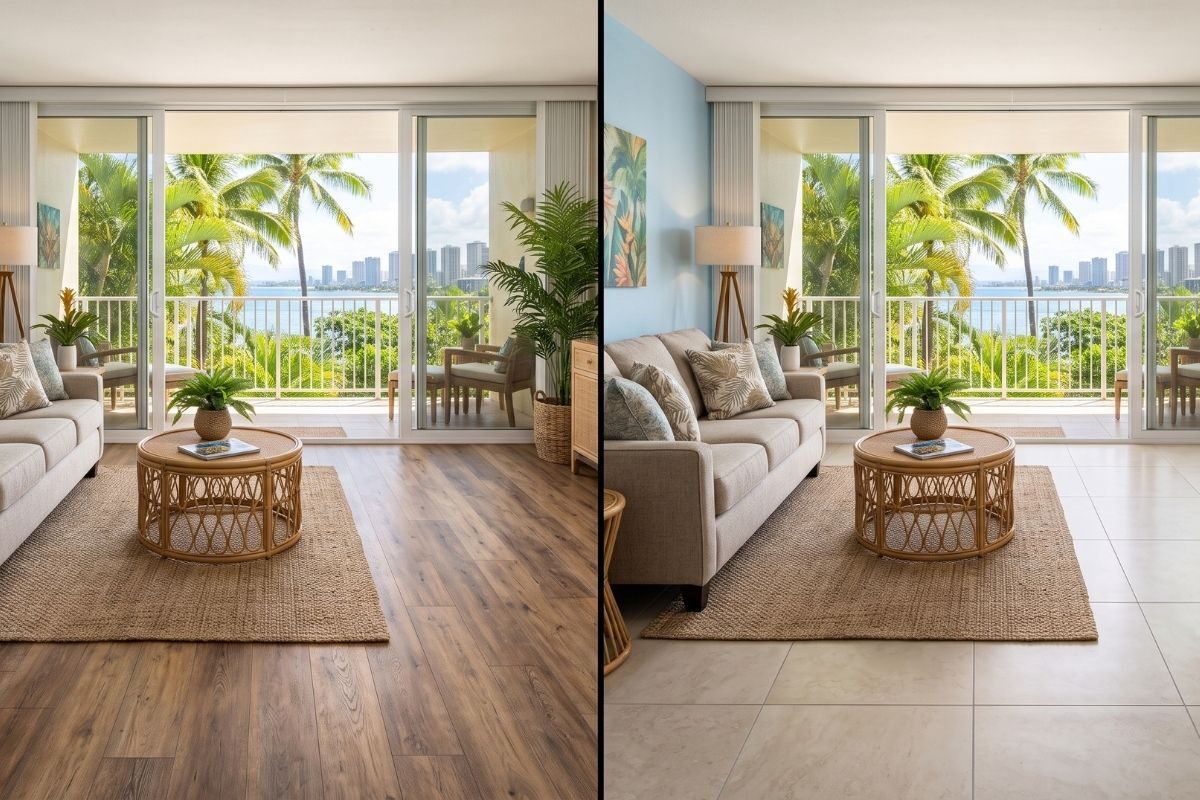
We hear it at least three times a week at our Honolulu showroom: which is better, LVP vs. tile flooring? Both handle Hawaii’s humidity well. And in the right rooms, both can look sharp — the decision comes down to how each performs under your specific slab conditions and how you actually live in your home.
Most mainland flooring guides miss the Hawaii-specific details entirely. Visit americanfloorandhome.com or call (808) 832-2000 to schedule a free consultation and talk through your actual space.
Why LVP and Tile Perform Differently in Hawaii’s Climate
Oahu’s subsoil is primarily basalt and crushed coral. That material transfers thermal mass into your concrete slab in ways that mainland soils do not. Tile, being a dense porcelain or ceramic product bonded directly to the slab, conducts that stored cool temperature directly to your feet. On a hot Honolulu afternoon, tile floors stay noticeably cooler underfoot — a real comfort advantage for people who live barefoot the way most island residents do.
LVP sits above the slab on a foam or cork underlayment. It stays closer to ambient room temperature. In air-conditioned spaces, LVP feels warmer underfoot, which is what most homeowners prefer for bedrooms and living areas.
Honolulu’s average relative humidity runs between 63% and 78% year-round, according to NOAA climate data (noaa.gov). Tile is fully impervious to humidity. LVP, when manufactured with a stone-plastic composite (SPC) core, is also highly stable in that range — far more so than traditional laminate or solid hardwood.
Pro-Tip from the American Floor & Home Installation Team:
In coastal Honolulu neighborhoods like Kaimuki, Hawaii Kai, and Aina Hana, we consistently recommend SPC-core LVP or large-format porcelain tile over any wood-based product. Before any installation, our team performs a slab moisture assessment — including ASTM F1869 or ASTM F2170 in-situ probe testing — to confirm what the slab is actually doing. That step is non-negotiable.
LVP vs. Tile: Quick Comparison for Oahu Homeowners
| Factor | LVP (SPC-Core) | Porcelain / Ceramic Tile |
| Comfort underfoot | Warmer, softer | Cooler, harder |
| Humidity resistance | Excellent (SPC core) | Excellent (fully impervious) |
| Condo IIC noise rating | Meets most HOA specs with proper underlayment | Usually requires additional padding |
| Installation speed | 1 day (after 24-48 hr acclimation) | 2-3 days (mortar + grout cure) |
| UV / sun resistance | Moderate (protect west-facing rooms) | Excellent |
| Scratch resistance | Good (choose 12+ mil wear layer) | Excellent |
| Drop / crack resistance | Flexes, will not crack | Can crack from heavy impact |
| Grout maintenance | None | Annual sealer in Hawaii’s hard water |
| Best rooms in Hawaii | Bedrooms, living areas, condos | Kitchens, bathrooms, lanai transitions |
| Hawaii climate rating | Very good | Excellent |
What Each Product Does Well in Hawaii
Luxury Vinyl Plank (LVP):
LVP wins on comfort. It is softer underfoot than tile, does not transmit cold from the slab, and is quieter to walk on — which matters enormously in a Honolulu condo with neighbors below you. Most condo HOAs here require a minimum IIC (Impact Isolation Class) rating for hard-surface flooring. The right LVP with proper underlayment can meet that requirement, but IIC is a system rating covering the entire floor assembly, not just the product alone. Always confirm with your building manager which assembly standard applies.
LVP also installs faster. Most projects complete in a single day after a 24-48 hour acclimation period. Our Cali and USFloors COREtec collections (americanfloorandhome.com/luxury-vinyl-flooring-info/) use a click-lock system that goes down quickly without mortar cure time.
The trade-offs are worth knowing. LVP can scratch without felt pads on furniture legs — choose at least a 12-mil wear layer for an active Hawaii household. Direct sun through west-facing lanai doors can fade the surface over time. Hunter Douglas shutters and shades (americanfloorandhome.com/window-coverings/) available at our showroom protect your LVP without blocking the natural light Hawaii homes are known for.
For daily cleaning, damp-mop with clean water and a manufacturer-approved cleaner. In coastal areas, salt residue from ocean air can build up on the wear layer over time and dull the finish. A clean water rinse after mopping goes a long way.
Tile Flooring:
Tile wins on longevity and hardness. A properly installed porcelain tile floor can last decades on Oahu with almost no degradation. It stands up to sand from Waimanalo Beach, heavy foot traffic, and direct afternoon sun without fading.
The trade-offs: installation takes longer due to mortar and grout cure time. In Honolulu’s moderately hard water, mineral deposits in unsealed grout appear faster than on the mainland. We recommend epoxy grout or a high-quality penetrating sealer in every Hawaii kitchen and bath tile installation. And if something heavy drops on tile, it can crack. LVP in the same situation would flex.
“I am very pleased with the flooring done by American Floor & Home. We replaced carpeting in our master and guest bedroom with vinyl tile. The floors look amazing. Thank you American Floor & Home.” Oahu Homeowner — luxury vinyl tile installation
Which Rooms Call for Which Product?
Bedrooms and living areas:
Most of our Honolulu clients choose LVP here. The comfort advantage wins for rooms where you spend time barefoot and relaxed. Our Hawaii Collections line (americanfloorandhome.com/hawaii-collections/) — including the Mauka to Makai laminate collaboration with Shaw, featured on Renovation Aloha Season 3 — offers wood-look options that feel warm and lived-in without the moisture risk of real hardwood.
“The Mauka to Makai collection is one of the first things we show customers who want the warmth of wood in a Hawaii living room,” says Trisha Makiya, Sales Manager at American Floor & Home. “It was designed with island light and lifestyle in mind, and it photographs beautifully in the open-plan homes we see most often on Oahu.”
Kitchens and bathrooms:
Tile remains our top recommendation here. The surface durability under water exposure, the cool-underfoot comfort near a hot stove, and the visual impact of large-format porcelain all suit a Hawaii kitchen well. Our Daltile and Emser Tile collections (americanfloorandhome.com/tile-flooring-info/) offer options that hold up for years on Oahu.
Open-plan indoor-outdoor transitions:
Tile is typically the stronger call at the lanai threshold. Sand, moisture, and UV at the transition zone are hard on LVP’s wear layer over time. Porcelain tile at the threshold with LVP inside the main living area is a combination we install regularly on Oahu.
“The team at American Floor & Home did an awesome job replacing the carpet in my condo with laminate flooring. They walked me through all the options and gave me the info I needed to make the right choice. The installers were on time, polite, and did a fantastic job. I’m really happy with how everything turned out!”
Oahu Homeowner — condo flooring, laminate installation
What to Ask Before You Buy
“Most homeowners come in having already picked a product based on photos online,” says Daniel Arita, who leads operations at American Floor & Home. “We always start with the subfloor conversation first. The right floor for your home depends on what your slab is telling us — and that is something photos on Pinterest cannot answer.”
Here are the questions worth asking any flooring company before you commit.
Has your slab been tested for moisture vapor transmission?
Our team runs ASTM F1869 or ASTM F2170 testing before every project. A slab emitting moisture vapor above the manufacturer’s threshold needs a mitigation system before any floor goes down — regardless of what the product’s marketing says.
What is the subfloor condition?
Older Honolulu homes built before 1985 often have irregular slabs that need grinding and patching before installation. Uneven substrate causes LVP to develop a hollow feel underfoot and can crack tile grout over time.
Does your HOA have IIC requirements?
If you are in a Honolulu condo, ask this question before you purchase anything.
Choosing the Right Installer on Oahu
The difference between a floor that lasts twenty years and one that fails in two is almost never the product. It is the installation.
Confirm that any installer runs a moisture test before the estimate. Confirm that their installers are in-house and CFI-certified — as our team is. Ask about their residential warranty: our 5-Star Installation Guarantee (americanfloorandhome.com/proper-installation/) covers any installation-related defect in residential flooring for five years. Most competitors offer a one-year residential warranty.
Before you visit, try our Roomvo room visualizer (americanfloorandhome.com/room-visualizer/) to preview LVP and tile options in a photo of your actual room. It takes two minutes and it changes the conversation considerably.
Frequently Asked Questions
Is LVP or tile better for a Hawaii condo?
For most Honolulu condos, LVP with proper underlayment is the better choice because it meets IIC noise requirements more easily, installs faster, and feels more comfortable underfoot in bedrooms and living areas. Tile is still preferred for kitchens and bathrooms. Confirm your HOA’s specific IIC requirement and which assembly standard applies before purchasing any hard-surface product.
Does humidity in Hawaii cause LVP to buckle?
Quality SPC-core LVP is highly stable in Oahu’s humidity range and significantly more resistant to moisture-related movement than laminate or hardwood. Moisture vapor rising through the slab is still a real risk factor. A reputable Hawaii flooring installer should test your slab before installation and apply a moisture mitigation system if readings are elevated.
How do I keep tile grout clean in a Hawaii home?
Use epoxy grout in kitchens and bathrooms where possible, or apply a high-quality penetrating sealer annually. Honolulu’s moderately hard water accelerates mineral buildup in unsealed grout. Clean with a pH-neutral floor cleaner — not vinegar or other acidic cleaners, which damage grout and natural stone surfaces over time.
Which flooring holds up better in a coastal Oahu home?
Both SPC-core LVP and large-format porcelain tile perform well in coastal zones near Hawaii Kai, Kailua, or Ko Olina with proper subfloor moisture mitigation. Protect LVP from prolonged direct UV through west-facing lanai doors with UV-blocking window treatments. Our team installs both flooring and window coverings, so these details can be handled in one project.
Can I mix LVP and tile in the same home?
Yes, and we do it regularly on Oahu. Tile in the kitchen, bathrooms, and lanai transitions; LVP in the living areas and bedrooms. The key is matching product thickness so there is no height difference at the transitions. Our installation team manages that detail on every mixed-product project.
Come See the Difference for Yourself
Stop by our Honolulu showroom at 302 Sand Island Access Rd, Honolulu, HI 96819, call (808) 832-2000, or use our Shop at Home service to have samples brought directly to your door. Our team will walk your space, assess the slab, and give you a straight answer.
Written by the American Floor & Home team — Honolulu’s CFI-certified flooring experts since 1974.
You Might Also Like
-
- Commercial Lvp
- Lvp Flooring
June 26, 2025
Commercial LVP Flooring: Durability, Design, and Cost Considerations
-

- Flooring Options
- Flooring Store
- Mold Prevention
June 17, 2025
How to Choose Mold-Resistant Flooring in Hawaii
-
- Beachy Flooring Style
- Engineered Hardwood
- Flooring Store
- Luxury Vinyl
April 22, 2025
Beach House Flooring: Stylish Solutions That Stand Up to Sand