

- Engineered Hardwood
- |
- Flooring
- |
- Flooring Hawaii
- |
- Hardwood Flooring
Why Your Engineered Hardwood Floors Are Buckling in Hawaii (And How to Stop It)
October 7, 2026
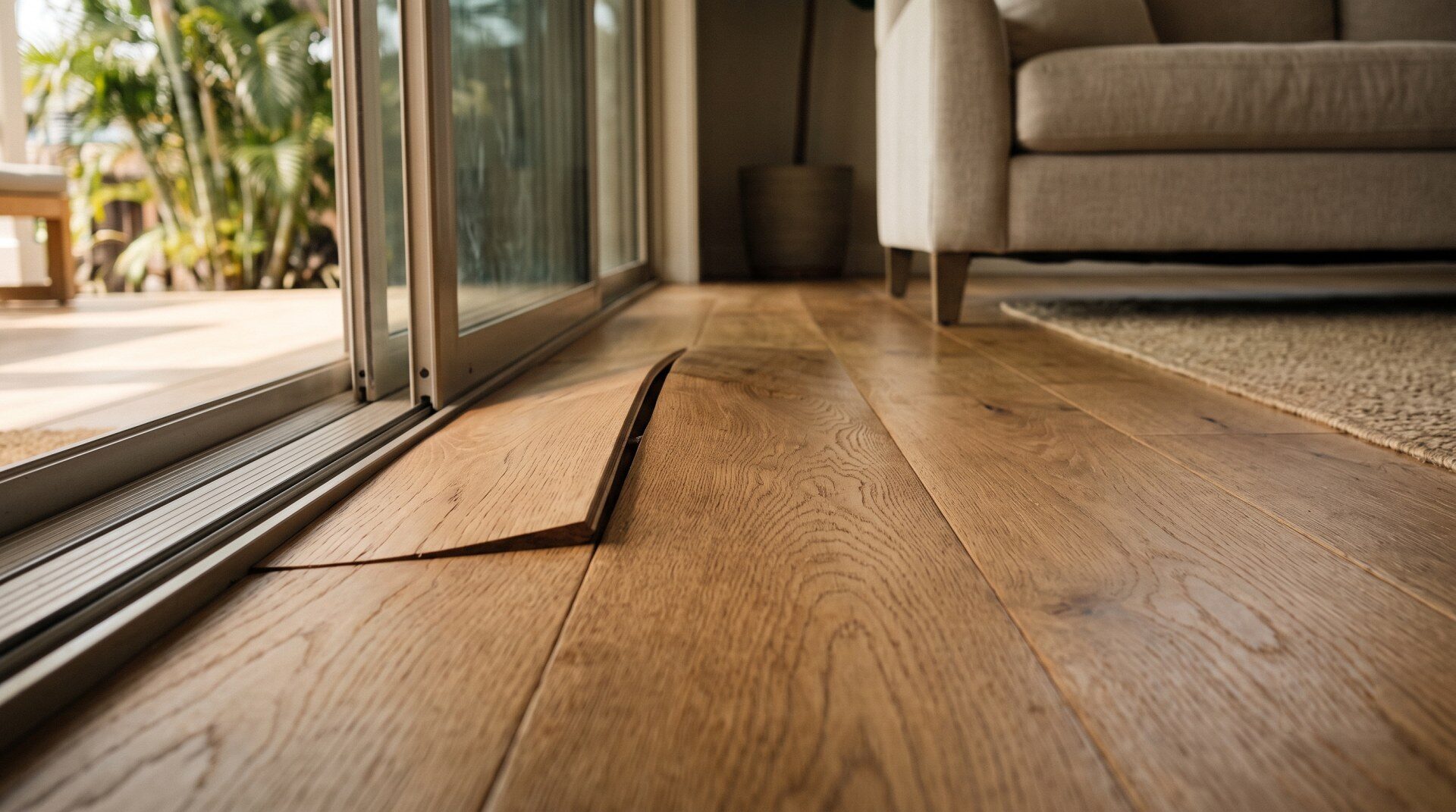
Your floors were fine last year. Now there is a ridge near the sliding door, a gap opening up along the wall, and sections that rock underfoot. You have not had a flood. You have not spilled anything. Hawaii did it.
This is one of the most common situations we see at our Kapolei showroom — and it is almost always preventable. If you are watching this happen right now, call us at (808) 466-8828 or visit americanfloorandhome.com before the damage spreads.
Why Engineered Hardwood Flooring Struggles in Hawaii’s Humidity
Engineered hardwood flooring in Hawaii’s humidity presents a challenge that mainland flooring guides almost never address. The cross-ply construction — layers of wood glued in alternating grain directions — resists expansion and contraction better than solid hardwood, but ‘resists’ is not the same as ‘immune.’
Honolulu’s average relative humidity runs between 63% and 78% year-round, per NOAA climate data (noaa.gov). The National Wood Flooring Association (nwfa.org) recommends maintaining indoor humidity between 35% and 55% for wood floors. Oahu’s baseline sits above that upper limit on most days, before you factor in cooking, showering, or the warm offshore trade wind air that rolls in off Mamala Bay.
The real wood veneer layer in engineered hardwood is hygroscopic — it absorbs and releases moisture based on the surrounding environment. When the floor’s environment exceeds the humidity it was acclimated to at installation, the wood expands. If it cannot expand freely, it buckles upward. If it repeatedly expands and contracts as conditions shift, the boards cup at the edges or gap at the seams.
West Oahu homes in Kapolei and Ewa Beach face a specific version of this challenge. Many were built post-2000 on engineered fill that compacts differently than the older coral-based soils of central Honolulu. Concrete slabs in these developments often run warmer in the afternoon due to the sun exposure pattern across the Ewa plain — and a warm slab increases moisture vapor pressure from below.
Pro-Tip from the American Floor & Home Installation Team:
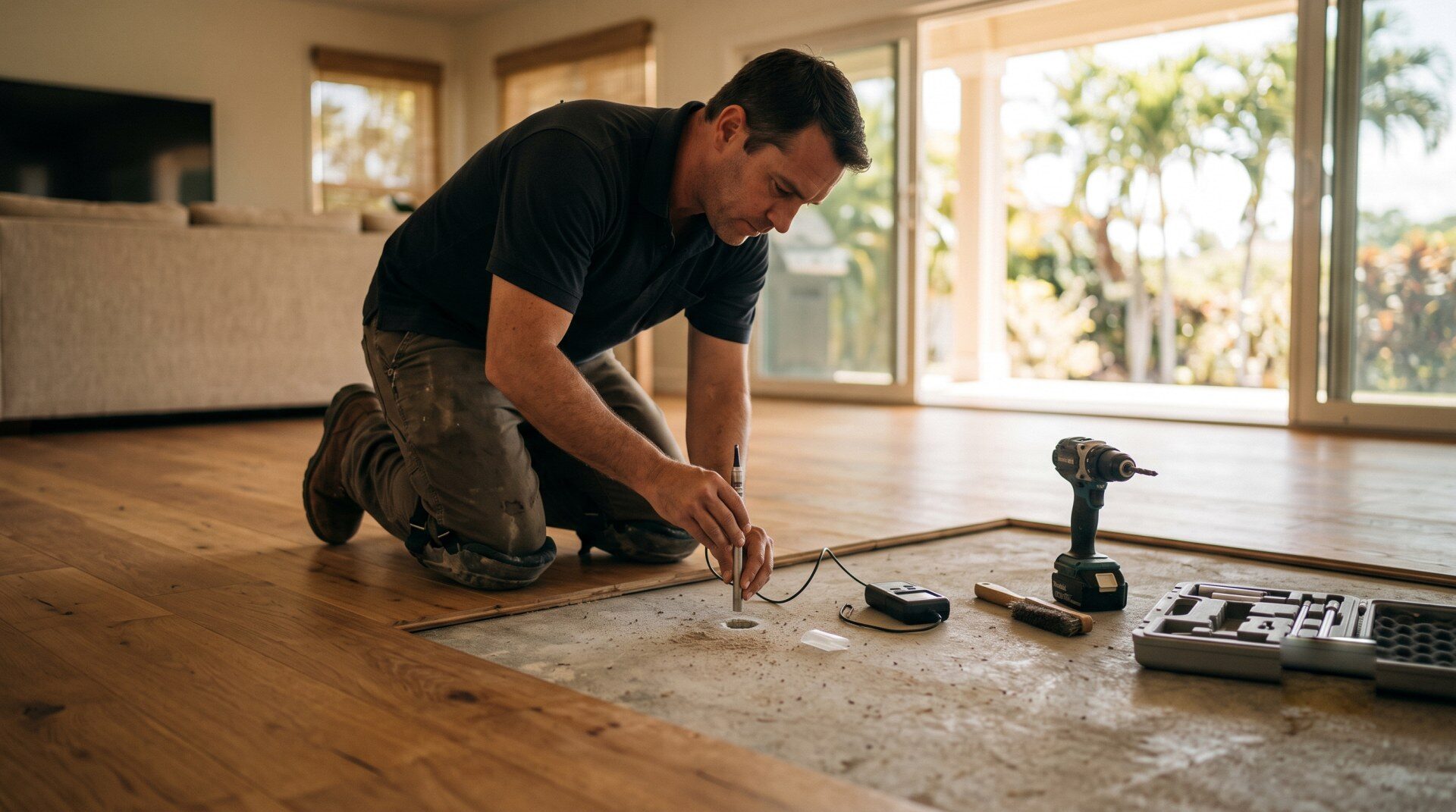
In Kapolei and Ewa Beach homes, afternoon slab temperatures can run 5-10 degrees warmer than in shaded Honolulu neighborhoods, which directly increases moisture vapor emission rates. Before any engineered hardwood installation in West Oahu, we test with ASTM F2170 in-situ RH probes — not just the older calcium chloride method — because the in-situ test captures what the slab is actually doing at installation depth, not just at the surface.
The Three Failure Modes: What You Are Looking At
Cupping:
The edges of each plank rise higher than the center. Seen from the side, each board looks like a shallow U. This is the earliest warning sign. Cupping means the bottom face is absorbing more moisture than the top — typically from the slab. Caught early, cupping can often stabilize if you reduce the moisture source. Dry it slowly — aggressively stripping humidity or applying heat can over-dry the boards and cause damage in the opposite direction.
Buckling:
Planks lift completely off the subfloor, sometimes forming dramatic ridges. This usually happens fast — after a plumbing event, a failed moisture barrier, or a particularly humid season. Buckling almost always requires reinstallation because the locking mechanism between boards is damaged.
Gapping:
Spaces open between planks. This is the opposite problem — the floor dried out and contracted. In Hawaii, gapping often happens in heavily air-conditioned rooms where the unit runs constantly and strips moisture from the air. Gapping alone can be cosmetic. Gapping combined with cupping elsewhere in the same house signals an unstable moisture environment and needs professional assessment.
Signs You Should Call a Professional Now:
- The buckling or cupping covers more than 20% of the floor area
- The floor has been failing for more than 60 days without improvement
- You have already turned on a dehumidifier and the problem is still getting worse
“Our downstairs flooring was in bad condition and it was time to get replaced. When the install happened, Nolan and his crew made us feel at ease, always communicated everything that was happening, and the work was done with quality and professionalism. We love our new floor!!”
Rochelle F. — flooring replacement, Oahu
What Actually Prevents Buckling: The Steps That Matter Before Installation
Most engineered hardwood failures in Hawaii are not product failures. They are installation failures — specifically, failures that happen before the first plank goes down.
“Moisture behavior in a West Oahu slab is different from what installers see on the mainland,” says Daniel Arita, who leads operations at American Floor & Home. “We built our pre-installation protocol around what Hawaii slabs actually do — not what textbook installation guides assume.”
And if your floors are still in good shape: this is the section worth reading before you start any hardwood project in West Oahu.
Step 1 — Moisture test the slab.
The ASTM F2170 in-situ RH probe measures moisture at mid-depth of the slab. A reading above the manufacturer’s published threshold — typically between 65% and 80% depending on the specific product — triggers a mitigation requirement. Our team runs this test on every project at our Kapolei showroom before any flooring is ordered.
Step 2 — Apply mitigation if needed.
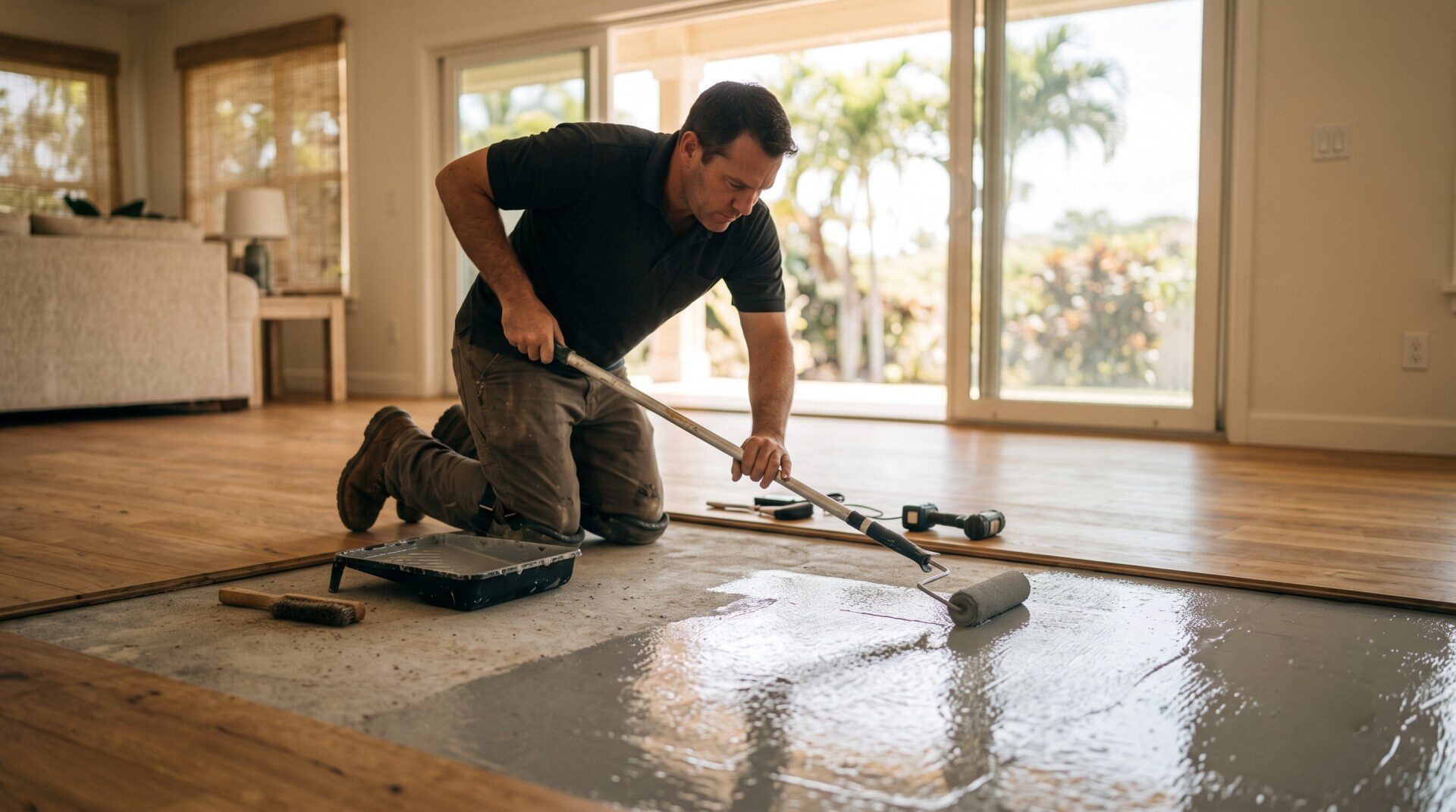
If the slab reads high, the right answer is an epoxy moisture barrier system — not switching to a different product and hoping. Epoxy mitigation seals vapor transmission at the source.
Step 3 — Verify subfloor flatness.
Most engineered hardwood requires the slab to be flat within 3/16 inch over 10 feet. In West Oahu newer construction, slab humps and settling low spots are common. Our team grinds high spots and applies self-leveling compound to low areas before any flooring goes down.
Not sure about your slab? Call (808) 466-8828 and we will run the test before you commit to anything.
Step 4 — Acclimate the product correctly.
Engineered hardwood needs 48 hours to 5 days of acclimation in the installation space — floating installations typically require 48 hours minimum; glue-down on high-moisture slabs may require up to 5 days. The HVAC must be running at the humidity level the home will actually maintain during that window.
Step 5 — Leave the right expansion gap.
The NWFA requires a minimum 3/4-inch expansion gap at all walls and vertical obstructions. In Hawaii’s humidity, our installers go to the high end of manufacturer tolerance. Also confirm with your installer that transition strips at doorways can accommodate the full expansion of the wood floor — a fixed reducer strip can create a pressure point that lifts the floor over time.
Our engineered hardwood selection (americanfloorandhome.com/hardwood-flooring-info/) features DuChateau, Anderson Tuftex, and USFloors — collections whose core construction is well-suited to Hawaii’s conditions. Our team recommends specific products based on your slab test results, not just showroom appearance.
Maintaining Engineered Hardwood in a Hawaii Home
The most common ongoing mistake is inconsistent climate control. Homeowners run the AC hard during the day and turn it off at night. The humidity swings that result — sometimes 15-20 percentage points between morning and evening — stress the wood more than any single high-humidity event. Engineered hardwood handles Hawaii’s baseline far better when that humidity is stable.
A whole-home dehumidifier is a worthwhile investment for Kapolei and Ewa Beach homes with hardwood floors. Target 45% to 55% RH consistently. A basic hygrometer near your floor will tell you what your home is actually doing.
For cleaning, use a barely damp microfiber mop with a pH-neutral cleaner in the 6-7 range — most hardware stores carry them. Alkaline or acidic cleaners strip the finish and accelerate moisture absorption over time. Never let water pool at seam lines.
For the long term: a light screen-and-recoat every 5-7 years in a managed Hawaii home extends the wear layer significantly. The wear layer thickness on your specific product determines whether a full refinishing is possible — confirm with the manufacturer before sanding.
“I appreciate it, Peter, Del, Marc, Scott, Ed, and Dion, and the great work they did with my floor installation. They were on time, worked hard, kept the area clean, were respectful of the surroundings, and worked with a high-level of professionalism.”
S. Merrill — flooring installation, Oahu
What to Look for in a West Oahu Flooring Installer
A flooring company that says ‘engineered hardwood is fine for Hawaii’ without asking about your slab is the wrong choice.
Ask for the moisture test results in writing. Any reputable installer provides them. If the reading is above the manufacturer’s threshold, ask specifically which epoxy system they use. ‘We’ll use a barrier’ is not a specific enough answer.
Confirm that installers are in-house and CFI-certified, as ours are. Ask about the warranty: our 5-Star Installation Guarantee (americanfloorandhome.com/proper-installation/) covers any installation-related defect in residential flooring for five years. Most competitors offer one year.
Frequently Asked Questions
Can engineered hardwood really be installed in Hawaii, or should I just use LVP?
Engineered hardwood absolutely works in Hawaii when installed correctly over a properly tested and prepared slab. The key variables are slab moisture testing, acclimation, expansion gaps, and consistent indoor climate control after installation. LVP is a strong alternative for rooms with higher moisture exposure or condo HOA noise requirements, but engineered hardwood is a legitimate and lasting option for Oahu homeowners who want real wood character.
My engineered hardwood is cupping — will it reverse if I run the dehumidifier?
Mild early-stage cupping sometimes reverses when you stabilize indoor humidity. If cupping appeared recently and is not severe, run your AC or dehumidifier consistently for two to four weeks and monitor. Dry it slowly — do not apply heat or aggressively strip humidity. If the cupping is pronounced, covers multiple boards across the room, or has persisted for months, a professional assessment is necessary as the damage may be permanent.
How long does engineered hardwood last in a Hawaii home?
A well-installed engineered hardwood floor in a properly conditioned Hawaii home should last 20-30 years or more. Wear layer thickness determines whether refinishing is possible — 3-4mm layers typically allow one or two sandings; thinner layers may not. The failure cases that shorten floor life in Hawaii are almost always installation or climate control issues, not product defects.
What is the difference between ASTM F1869 and ASTM F2170 moisture testing?
ASTM F1869 (calcium chloride test) measures moisture vapor emission at the slab surface over 60-72 hours. ASTM F2170 (in-situ RH probe) measures relative humidity inside the slab at depth — the level that influences your floor over its lifetime. For Hawaii’s warm slabs, F2170 gives a more accurate picture of long-term conditions, which is why our team uses it for all West Oahu engineered hardwood projects.
Does the 5-Star Installation Guarantee cover moisture-related failures?
The guarantee covers installation-related defects — failures from improper technique including inadequate expansion gaps, missed moisture testing, and incorrect acclimation. Product failures or homeowner-created moisture events fall under manufacturer warranty. Our team documents pre-installation moisture test results on every project, so the baseline is on record from day one.
If Your Floors Are Already Moving
Come see us before ordering anything new. A visual assessment and moisture test are the only ways to know whether you have a fixable situation or a full reinstall in front of you — and that conversation is always free.
Stop by our Kapolei showroom at 480 Kamokila Blvd, Suite B3, Kapolei, HI 96707, or call (808) 466-8828. Our Shop at Home service brings samples and a free assessment directly to you, and our financing options can make a full remediation and reinstall manageable. Kapolei location details at americanfloorandhome.com/kapolei-hi/.
Written by the American Floor & Home team — Oahu’s CFI-certified flooring experts since 1974.
You Might Also Like
-
- Beachy Flooring Style
- Flooring
- Flooring Hawaii
- Flooring Options
- Flooring Tips
- Lvp Flooring
- Tile Flooring
September 18, 2026
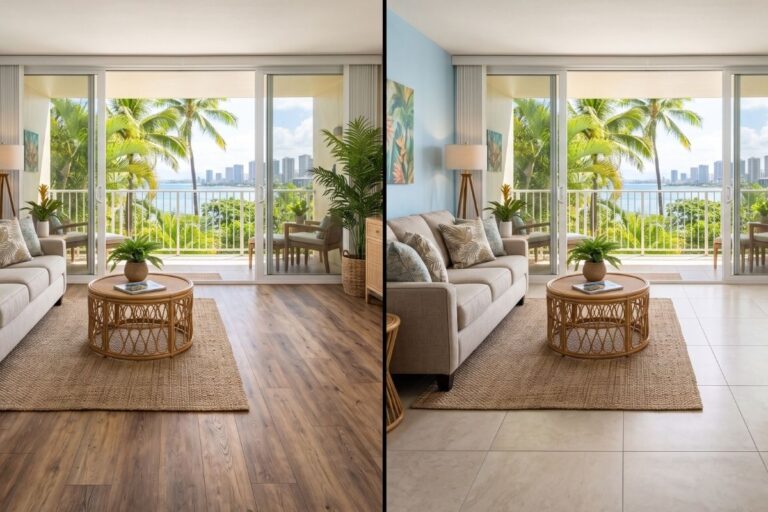
LVP vs. Tile Flooring in Hawaii: Which One Actually Wins for Oahu Homes?
-
- Hardwood Flooring
- Textured Wood
July 7, 2025
Uncover the World of Wood Floor Texture & How it Impacts Your Home
-
- Hardwood Flooring
- Hardwood Sealing
July 2, 2025
Protect Your Wood Floor Investment with Hardwood Floor Sealants